
Across Syracuse, deer management is often discussed in terms of public safety, damaged gardens, vehicle collisions, and the growing spread of ticks. Yet the story does not end when nuisance deer are removed from neighborhoods.
A little-known process takes place behind the scenes, connecting wildlife management efforts with food assistance programs that serve families across Central New York.
At the center of that process is Marsh Mill Ranch in Kirkville, New York, where deer removed through municipal management programs are carefully processed and transformed into thousands of pounds of venison.
That meat eventually reaches food pantries throughout the region, providing a valuable source of protein to people who need it most.
Where the Process Begins
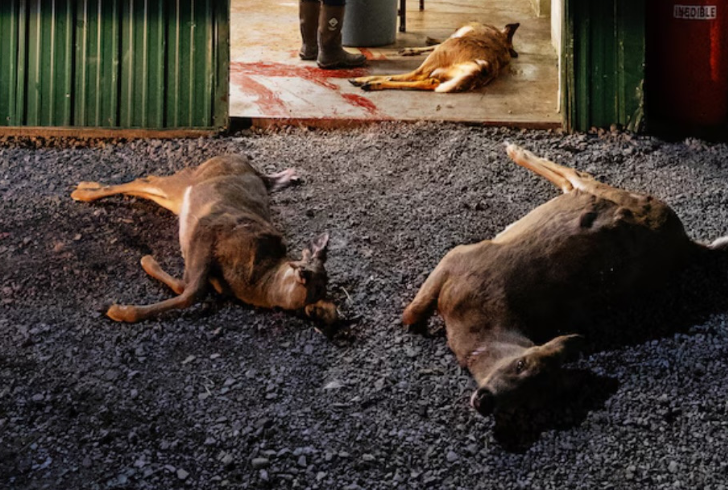
During late March, trucks operated by the U.S. Department of Agriculture Wildlife Services arrived at Marsh Mill Ranch carrying deer harvested through local deer management operations. Many of the animals came from Syracuse neighborhoods and parks as part of the city’s Tick and Deer Management Program. Others were collected from communities such as Fayetteville and DeWitt.
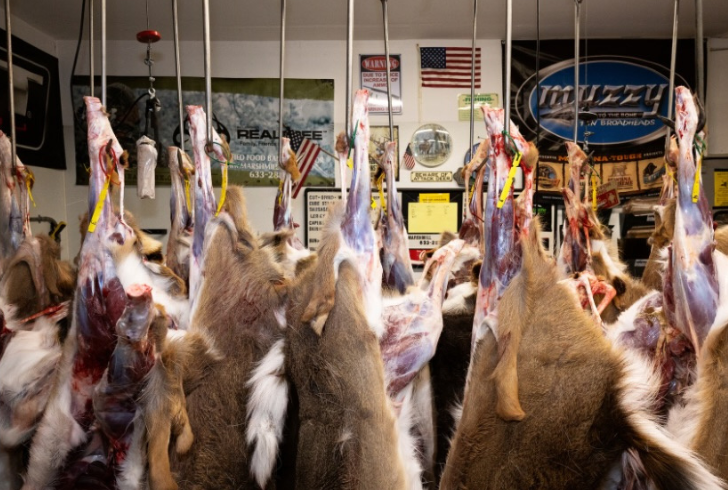
The facility itself resembles a working slaughterhouse, complete with concrete floors, overhead meat hooks, processing equipment, and refrigeration systems designed to handle freshly harvested animals.
On one particularly busy night, 17 deer arrived within a few hours, making it the most active evening at the facility in more than a month. According to Marsh Mill Ranch owner Don Cottet, Syracuse’s unofficial deer removal total for the winter of 2026 reached 144 deer. That figure marked the highest annual total since 2020, when sharpshooters removed 159 deer according to city records.
The deer arriving at the facility were still warm, making rapid processing essential to preserve meat quality.
Skilled Hands Behind the Work
Processing begins almost immediately after arrival. Don Cottet and cutter Adam Sacco handle much of the initial work.
Sacco’s experience with deer processing started early. He dressed his first deer at age six and began working part-time at Marsh Mill Ranch when he was 17. Over the years, more than 1,000 deer have passed through his hands. According to Sacco, a freshly harvested deer can be field dressed in as little as two minutes.
Cottet brought a different background to the operation. Before purchasing Marsh Mill Ranch in 2021, he worked as a restaurant chef and spent more than two decades processing deer. His culinary training shaped the standards used throughout the facility.
The process requires speed and precision. Deer are hoisted onto overhead racks using motorized systems. Heads are removed, blood is drained, and hides are opened carefully to avoid damaging internal organs. Teams often work only inches apart while handling sharp knives and saws.
Reflecting on years of working together, Sacco joked, “We’ve stabbed each other a couple of times.”
Cottet added with a laugh, “It’s usually on Tuesdays. We call it stabby-stabby Tuesdays.”
The humor helps break up physically demanding work performed during overnight hours.
Making Use of Every Part of the Animal
One of the most remarkable aspects of the operation is how little goes to waste.
During processing, valuable parts of each deer are set aside for different purposes. Hearts are frequently donated to the biology department at Fayetteville-Manlius High School, where students use them for educational study. According to Cottet, batches of roughly 60 hearts are often delivered to the school.
Other parts find equally practical uses. Some individuals request hearts and livers for food or dog feed. Leg bones are collected for soup stock. Blood is saved for trainers working with tracking dogs. Sinew is supplied to craftspeople who create traditional bow strings.
Even deer tails have a destination. Approximately 50 tails are shipped to a fisherman in Connecticut who uses them to create trout flies.
Members of the Onondaga Nation collect hooves to make traditional leg rattles. Internal organs and scraps are often recycled as coyote bait.
This approach reflects a long-standing philosophy among processors and hunters alike: use as much of the animal as possible.
The Cost of Processing Deer
The work is physically demanding and comes with its own challenges.
Processing often continues until the early morning hours. Floors must be cleaned, equipment sterilized, and carcasses properly stored for later butchering.
For handling deer removed through management programs, the USDA pays Marsh Mill Ranch approximately $55 per deer. According to Cottet, that amount primarily covers operational expenses rather than generating significant profit.
The financial return comes later when venison is processed for donation programs.
The work also exposes employees to ticks. On one occasion, Cottet discovered a fresh tick bite after completing a processing shift. Looking at the mark, he simply described it as the “cost of doing business.”
Why Syracuse Removes Deer
The Syracuse Tick and Deer Management Program was created to address several ongoing concerns.
Large deer populations contribute to higher tick densities, increasing the risk of tick-borne illnesses. Deer also cause significant damage to residential landscaping and gardens. Vehicle collisions involving deer remain another concern throughout many parts of Central New York.
Although Syracuse does not have a precise citywide deer population estimate, wildlife specialists note that deer densities generally need to drop below 10 deer per square mile before local tick populations begin to decline significantly.
The city’s East Side is believed to support approximately 15 deer per square mile, making it one of the highest-density areas in Syracuse.
New York State Assembly Member Pamela Hunter, who represents the 128th Assembly District and lives on the East Side, believes residents have noticed meaningful changes.
“When I was first elected in 2015, the number one constituent issue that people brought to my attention was the deer,” Hunter said.
She added that fewer plants are being eaten and fewer deer droppings appear in neighborhood yards compared to previous years.
Retired wildlife biologist Andy Saunders has observed similar results in the university neighborhood.
“There’s clearly no doubt the number of deer has been reduced since they started the culling program,” Saunders said.
Even so, he noted that deer continue to browse gardens and consume native vegetation in Barry Park, creating opportunities for invasive plant species to spread.
As Saunders explained, the program has reduced the problem, but it has not eliminated it.
Turning Venison Into Food for Families
The most significant outcome of Syracuse’s deer management effort may not be measured by population numbers alone.
Thousands of pounds of venison generated through the program eventually reach residents facing food insecurity throughout Central New York.
Andrew Katzer, Director of Procurement for the Food Bank of Central New York, views venison donation programs as an effective way to provide nutritious protein.
“Protein is one of the most needed items,” Katzer said.
While venison represents a relatively small percentage of overall food distribution, its impact extends far beyond the numbers.
Records provided by Marsh Mill Ranch and Syracuse indicate that the city’s deer management program has generated nearly 20,000 pounds of venison since its launch. That amount translates to approximately 80,000 meals.
When venison donated through similar deer management programs in DeWitt and Fayetteville is included, the estimated total reaches roughly 250,000 meals.
Katzer described the system simply: “Neighbors feeding neighbors.”
Supplying Food Pantries Across the Region
The Food Bank of Central New York distributes donated venison to approximately 500 food pantries located throughout 11 counties.
Many of those organizations serve Syracuse residents directly.
One example is the West Side Food Pantry at Brown Memorial Church. The pantry typically receives about 100 pounds of ground venison each winter.
According to volunteer Esther Crossman, the meat is consistently popular among the pantry’s roughly 400 monthly clients.
Many recipients are unfamiliar with venison at first. Volunteers often suggest treating it like ground beef while adding preferred seasonings.
Crossman recalled the frequent requests that arrive after supplies run out.
“When we run out, everybody’s like, ‘You don’t got no more of that venison?'”
The reaction highlights both the quality of the meat and the growing demand for affordable protein sources.
The Butchering Process
Once carcasses have cooled, processing moves into a second stage.
Teams return to skin, trim, and butcher each deer. Hides are carefully removed, and any remaining hair is singed away using propane torches.
Sacco refers to skinning as “pulling their pajamas off.”
The hides themselves retain value. A fur trader purchases them for approximately $10.50 each.
As butchering continues, premium cuts such as tenderloins and backstraps are removed first. Shoulders, legs, and haunches are separated and prepared for trimming.
Every deer receives the same level of care given to animals processed for paying hunters.
Cottet follows strict standards.
“If it’s white, or bloody, it doesn’t go in,” he explained, referring to fat, connective tissue, and damaged meat.
Areas surrounding bullet wounds are discarded to maintain quality.
Why Venison Yields Are Lower
Processing deer removed during late winter presents unique challenges.
According to Cottet, deer harvested in March produce substantially less meat than animals taken during the traditional fall hunting season.
On average, each deer processed through the management program yields approximately 27.2 pounds of venison.
By comparison, the National Deer Association estimates that hunters often recover roughly 48 percent of a deer’s dressed weight as usable meat. A 140-pound dressed deer could provide approximately 67 pounds of venison under ideal conditions.
Winter conditions explain much of the difference.
After months of cold weather and limited food availability, deer carry very little body fat and often weigh less than they do during autumn.
Many of the animals processed through municipal programs are also younger deer. While hunters often target mature animals, wildlife management teams focus on reducing overall population numbers efficiently.
Shot placement also affects yield. Depending on the impact location, rifle rounds can damage as much as 15 pounds of meat.
A neck shot may preserve shoulder meat but eliminate several pounds of neck meat. Other shot placements can reduce usable portions even further.
From Premium Cuts to Ground Venison
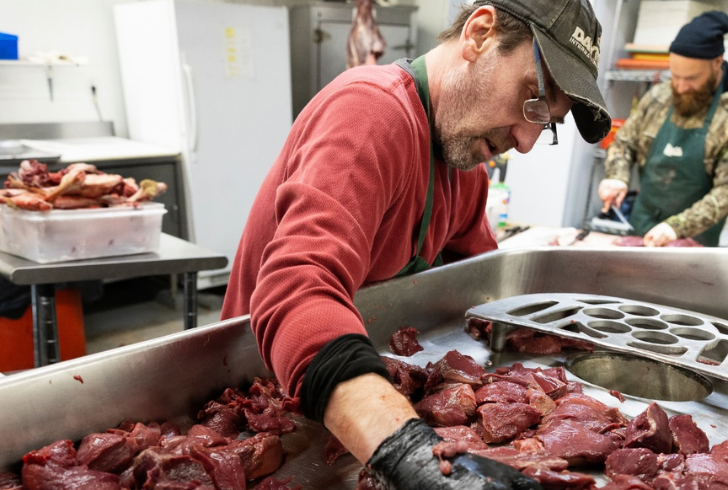
At the end of a processing day, workers may trim hundreds of pounds of steaks, roasts, and stew meat from harvested deer.
Rather than packaging individual cuts, nearly all of the meat is converted into ground venison.
For many hunters, grinding premium cuts would seem almost unthinkable. Yet the approach allows food banks to distribute meat more efficiently and serve more households.
As Sacco noted, “Some people cry when he puts that into the grind, but it is what it is. It goes to a good cause.”
The Food Bank of Central New York reimburses Marsh Mill Ranch approximately $3.50 per pound of ground venison using state-supported funding programs administered through Feeding New York State.
The New York State Department of Environmental Conservation reports that between 50,000 and 70,000 pounds of hunter-donated venison are distributed statewide each year.
Marsh Mill Ranch alone contributes between 6,000 and 7,000 pounds annually, representing more than half of the Food Bank of Central New York’s total venison supply.
For Cottet, the motivation remains straightforward.
“It feeds the community,” he said. “They’re giving this out to people that really, really need it.”
How Venison Reaches Local Tables
The impact of these donations becomes clear once the meat reaches local food pantries.
At the Verona Food Pantry, coordinator Peg Ward said many recipients grew up eating venison and welcome its return each season.
The pantry receives about 30 pounds at a time, though supplies disappear quickly.
“We like to have a lot of meat on hand since it’s so costly,” Ward explained. “So having the venison is just a big plus for the people to be able to get the protein.”
One recipient, 81-year-old Santos Garcia, recently prepared the last venison steaks remaining in his freezer. The meat came from a donated deer processed by a neighboring butcher and distributed through the pantry.
Garcia appreciated the quality of the meat, saying, “It’s fresh, good meat, and you don’t have to worry about chemicals.”
The steaks were soaked in water and vinegar before being cooked with peppers, onions, and homemade sofrito. Served over rice, the meal reflected the final stage of a process that began months earlier in Syracuse neighborhoods.
Syracuse’s deer management program helps reduce issues related to ticks, property damage, and vehicle collisions while also supplying nutritious food to local communities.
Since the initiative began, nearly 20,000 pounds of venison have been distributed through the Food Bank of Central New York, providing an estimated 80,000 meals. When contributions from neighboring communities are included, that figure rises to roughly 250,000 meals.
What starts as a wildlife management effort ultimately supports food assistance programs across the region, providing a valuable source of protein for thousands of residents.